
 EN
EN ES
ES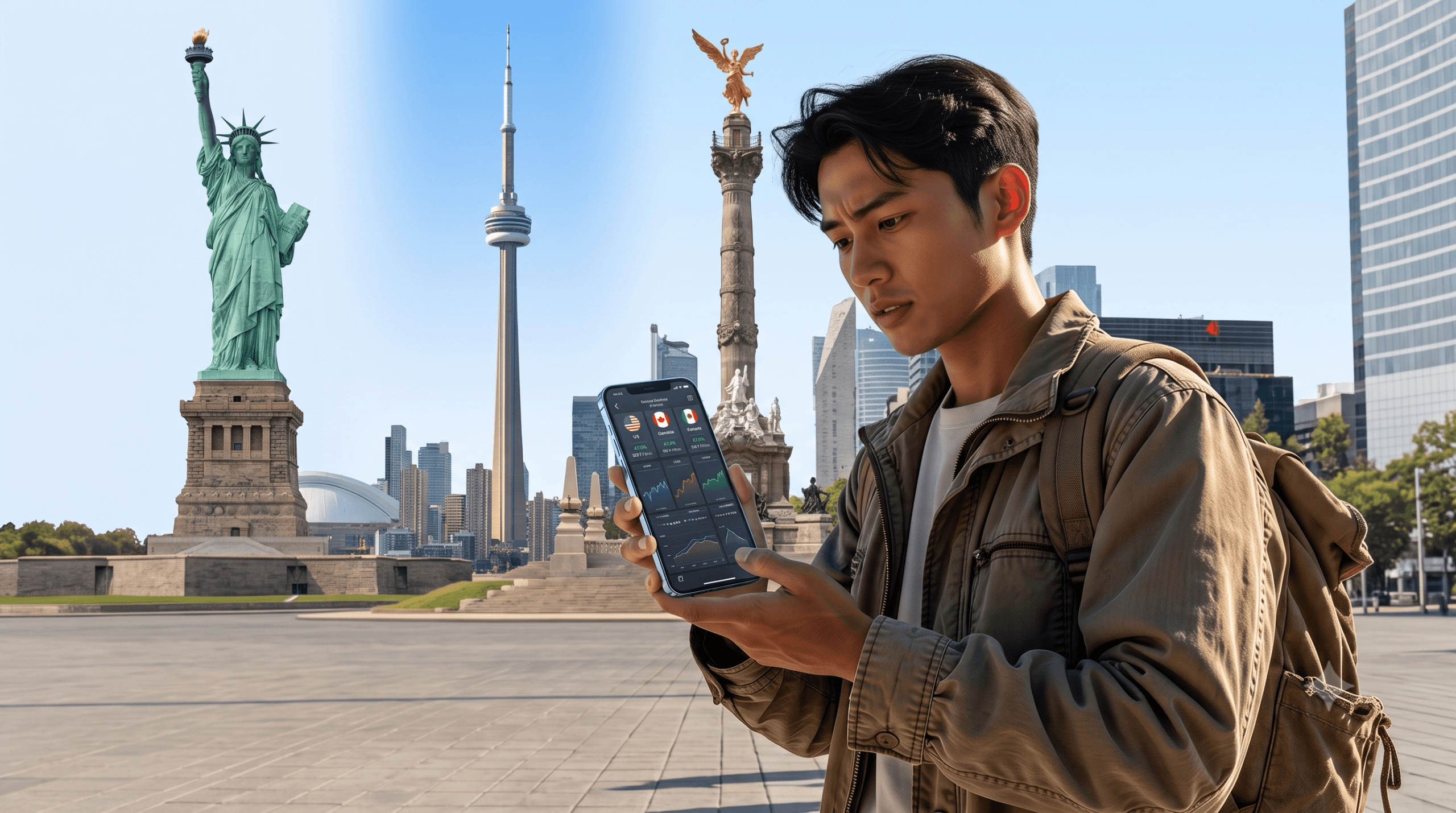
If you're planning a trip to North America, whether it's a week in New York, a road trip through Canada, or a month exploring Mexico, staying connected is essential. But choosing the best eSIM for North America planning ahead can help you avoid expensive roaming fees, wasted time in operator stores, and being left without a connection at the worst possible time.
A fixed-rate global eSIM that covers all three countries—the US, Canada, and Mexico—on a single plan is the smartest option for most travelers. Here's why and how to choose the best option for your itinerary.
Why you need a data plan before you land
Most travelers only think about connectivity after they land, and that's when the problems begin.
Without an active data connection, you can't check your hotel's address, see which subway line to take from the airport, or let your family know you arrived safely. In all three North American countries, the difference between arriving with a working internet connection and relying on airport Wi-Fi can make your arrival a comfortable or stressful experience.
The three main options that travelers usually consider are:
- International roaming from your usual operator
- A local physical SIM card purchased at the destination
- An eSIM activated before or during the trip
Each option has its advantages and disadvantages. By the end of this guide, you'll know exactly which one is best for you.
Connectivity in the USA: What travelers should know
The United States boasts excellent mobile infrastructure, with 4G LTE coverage available in most urban and suburban areas, while 5G continues to expand rapidly in major cities like New York, Los Angeles, Chicago, and Miami. For travelers, staying connected is easier than ever with an eSIM for the USA, which offers instant activation, reliable coverage and seamless internet access without the need for a physical SIM card.
Network coverage
The three major carriers—AT&T, T-Mobile, and Verizon—cover virtually the entire continental United States. Rural areas and national parks may experience signal interruptions, but most major routes and popular tourist destinations have good coverage.
Roaming in the USA
For travelers arriving from Europe, Latin America, or Asia, roaming costs in the U.S. are typically high. Many plans charge between $10 and $15 per day just for roaming access, and data speeds are usually throttled after 100–200 MB. If your stay is longer than three or four days, you'll likely pay more for roaming than you would with a dedicated travel eSIM.
Local SIM cards in the USA
T-Mobile or AT&T prepaid SIM cards are available at airport kiosks and convenience stores. Prices typically start between $30 and $40 for a 7-day plan with limited data. The downside is that you'll have to swap your physical SIM, lose direct access to your regular number, set up the card upon arrival, and the SIM will become unusable once you cross into Canada or Mexico.
Connectivity in Canada: What travelers should know
Canada covers a vast geographical area, but most of its population and mobile infrastructure are concentrated near the US border. Travelers can expect excellent coverage in major cities like Toronto, Vancouver, Montreal, and Calgary, while rural and northern areas may have limited connectivity. Choosing the best eSIM for Canada it guarantees reliable mobile data, a smooth connection, and convenient internet access throughout your trip.
Network coverage
Rogers, Bell, and Telus are the three main carriers in Canada. Although coverage maps appear extensive, travelers may encounter weak signals outside major urban centers. Canada's vast natural expanse means that remote areas can have long stretches without service.
Roaming in Canada
Canada has historically been one of the most expensive roaming destinations for international visitors. Daily roaming packages from major carriers typically cost between $10 and $15 per day, with data limits that run out quickly. A week in Canada using roaming with a European carrier can easily cost between $80 and $100 in connectivity alone.
Local SIM cards in Canada
Rogers or Bell prepaid SIM cards are available at major airports and shopping malls. However, Canadian prepaid plans are typically more expensive than similar options in the US or Mexico, ranging from $40 to $60 for a two-week plan with limited data. Add in the time spent waiting in a store after a long flight, and it's rarely the most efficient option.
Connectivity in Mexico: What travelers should know
Mexico has significantly improved its mobile infrastructure over the past decade. Telcel, the dominant operator, offers solid coverage across most of the country, including tourist destinations such as Cancún, Mexico City, Guadalajara, Oaxaca, and the Riviera Maya. Choosing the best eSIM for Mexico it allows travelers to conveniently access reliable mobile data without paying expensive roaming fees.
Network coverage
4G LTE is widely available in cities and tourist areas. Remote villages, jungle areas, and some mountainous regions may rely on 3G or have no signal at all. For most travelers visiting popular destinations, connectivity is generally reliable.
Roaming in Mexico
If you're from the US or Canada, some carriers include Mexico in North American roaming packages, but be sure to check the fine print. Speed limits, daily caps, and fair use policies mean that "included" doesn't always mean "actually useful." Travelers from Europe, Asia, or Latin America typically face standard international roaming rates, which can reach $15 per day.
Local SIM cards in Mexico
Telcel and AT&T Mexico sell prepaid SIM cards at airports, OXXO stores, and telecommunications outlets. Prices are competitive: a 30-day plan with 10 GB of data can cost as little as $15 to $20 USD. The limitation is the same as in other countries: you lose direct access to your regular phone number, and the SIM card only works in Mexico.
Roaming vs. Physical SIM vs. eSIM: A Real Comparison
Here's a clear comparison of the three options for a typical 10-day trip through North America covering two or three countries:
| Option | Typical cost 10 days | Setup time | It works in all 3 countries | Keeps your number |
|---|---|---|---|---|
| International roaming | $100–$150 | Instant | Yes, at a high cost | Yes |
| Local SIM by country | $60–$120, 3 SIMs | 30–60 min per country | Only within each country | No |
| global eSIM fixed rate | $35–$50 | Less than 5 minutes before traveling | Yes | Yes |
The comparison is simple. Roaming is by far the most expensive option, and physical SIM cards require time, planning, and number changes global eSIM with a fixed daily rate, it wins in almost every aspect for multi-country travel.
How to stay connected in all three countries
This is where many travelers face a crucial decision: if you're visiting more than one country on a North American trip—for example, landing in the US, crossing into Canada to see Niagara Falls, and then flying to Mexico City—you need a seamless connectivity solution. Choosing a North American international data plan helps eliminate the hassle of managing multiple SIM cards or separate mobile plans while traveling.
The problem with country-specific plans
Most eSIM providers sell country-specific plans. That means you might need one plan for the US, another for Canada, and a separate one for Mexico. Each has its own data allowance, validity period, and activation process. Managing multiple plans can quickly become confusing, especially when traveling in several countries. A North American travel SIM card solves this problem by offering unified coverage in the US, Canada, and Mexico under a single, convenient plan.
Why a fixed-rate eSIM changes everything
Blink eSIM works differently. A single eSIM works in over 190 countries with a flat rate of $3.5/day, the price is the same whether you're using 5G in New York, 4G in Toronto, or LTE in Cancun. You install it once before leaving home. It connects automatically when you land. No apps, no complicated setup, and no manually changing your country. Everything is managed through WhatsApp, a tool most travelers already
Step by step: how to connect before flying
- Check that your phone is compatible with eSIM. Most iPhones from the XS onwards and flagship Android phones are.
- Visit dashboard.blinkesim.com and click on “Get your eSIM via WhatsApp”.
- Complete the quick registration via WhatsApp; it takes less than 5 minutes.
- Install the eSIM profile on your device: Settings → Mobile data/Cellular → Add eSIM.
- Keep your physical SIM active for calls and SMS; the eSIM takes care of the data.
- Land in North America and connect automatically, without taking any further action.
Your usual number remains active at all times. WhatsApp, banking apps, and 2FA codes continue to function normally.
Conclusion
North America comprises three distinct countries with three different carrier ecosystems, three sets of roaming rules, and three tourist SIM options. For a trip that includes even two of them, the logistics of physical SIM cards and country-specific plans quickly become impractical.
The best eSIM for North America is one that works seamlessly in the US, Canada, and Mexico, without requiring you to do anything different at each border. A fixed rate keeps costs predictable. Automatic connection upon landing means you'll never be without a map or a way to contact your accommodation.
If you're planning a trip to North America, whether it's a week in the US, a cross-border road trip, or an extended stay across all three countries, set up your connectivity before you leave. It takes five minutes and is one of those travel tasks that pays for itself even before you leave the airport.
Frequently Asked Questions
Does a single eSIM work in the US, Canada, and Mexico?
Yes. A global eSIM from a provider like Blink eSIM covers all three countries in a single plan. You don't need to buy separate plans for each country or reinstall anything at each border.
Is an eSIM cheaper than roaming in North America?
Almost always. International roaming with most carriers costs between $10 and $15 per day per country. A fixed-rate global eSIM at $3.50/day is 60% to 75% cheaper and doesn't throttle speeds after a daily limit like many roaming packages do.
Can I keep my regular phone number using an eSIM in North America?
Yes. An eSIM works alongside your existing physical SIM. Your regular number remains active for calls and texts. The eSIM handles your mobile data connection while abroad.
Which countries have the best mobile coverage in North America?
The US generally has the broadest and fastest coverage. Canada has good coverage in urban areas, but weak signal in rural and northern regions. Mexico offers reliable coverage in cities and tourist destinations, though some remote areas may rely on 3G.
Do I need to buy a new eSIM for each country in North America?
Not if you use a fixed-rate global eSIM. With Blink eSIM, a single installation covers your travels to any of the more than 190 available countries indefinitely. Your balance is valid for 24 months, and you only pay for the days you actually travel.